The Occupation Observatory
AI and the Transformation of Work: Structural Convergence or Divergence?
Is AI truly democratizing opportunity in the labor market, or is it deepening skill-based inequality?
Which occupations are becoming structurally dependent on AI competencies and which are being left behind?
Are we witnessing a gradual transformation of work or a structural reconfiguration of occupational systems?
Introduction:
The increasing penetration of Artificial Intelligence (AI) is fundamentally reshaping how individuals perform their professional roles across occupational domains. Although AI is widely celebrated for its substantial contributions to efficiency, productivity, and task automation, a significant knowledge gap persists regarding the requisite technical and procedural know-how. This gap not only reflects uneven adaptation across the workforce but also has the potential to induce additional structural shifts in the skill requirements and qualification profiles evident in contemporary job listings. In this study, we comprehensively assess the transformative impact of automation and AI adoption on labor market dynamics by leveraging large-scale job listing data. Vacancy advertisements from major job platforms, including LinkedIn, Indeed and Glassdoor, are systematically collected to capture macro-level trends in demand for AI-related skills and roles. Each job posting is mapped to a job category using the Standard Occupational Classification (SOC) to standardize occupational taxonomy and enable rigorous cross-occupational comparisons.
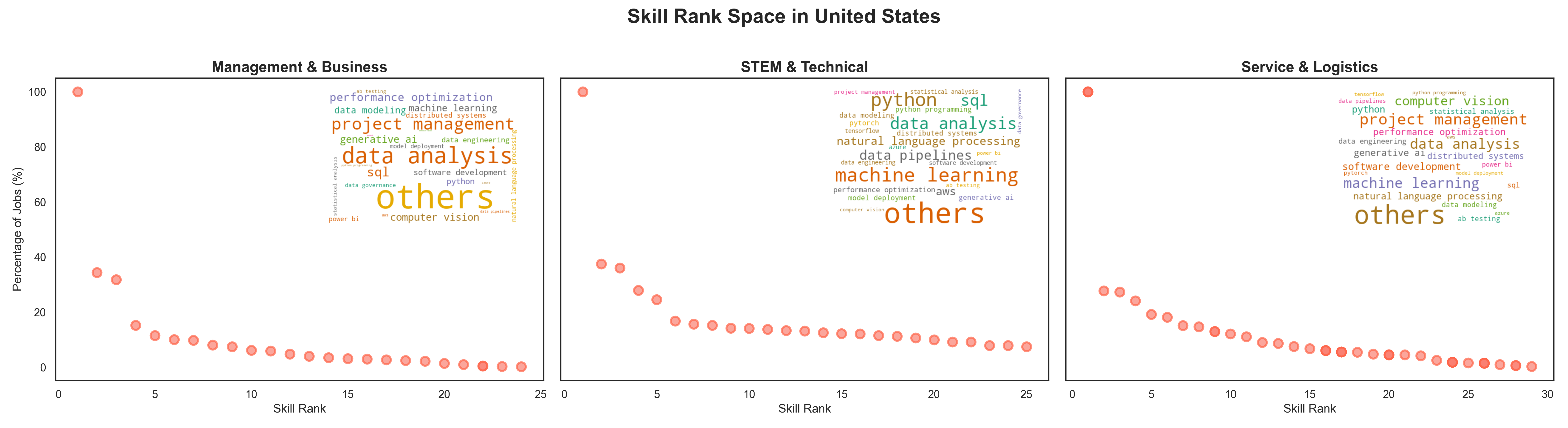
Skill Rank Space